Project Description
The Employee Database Analysis project simulates a real-world enterprise environment by managing over 300,000+ employee records using PostgreSQL. The challenge was structured to reinforce key concepts in relational database design, data transformation, and analytical querying. The goal was to model an enterprise employee database, build it through SQL scripts, and extract meaningful insights from the data.
This project was developed as part of a Data Analytics Bootcamp and demonstrates proficiency in SQL schema design, data engineering processes, and advanced querying techniques to answer business-driven questions about employee records, departments, and organizational structure.
Data Modeling
Using an Entity Relationship Diagram (ERD), the relational structure of the database was carefully designed and normalized to reduce redundancy and maintain data integrity. The following core entities were modeled:
- Employees: Core data like name, title, gender, and hire date
- Titles: Job title identifiers for employee roles
- Salaries: Employee salary history
- Departments: Department names and codes
- Department Employees: Mapping between employees and their departments
- Department Managers: Mapping between departments and their managers
Data Engineering
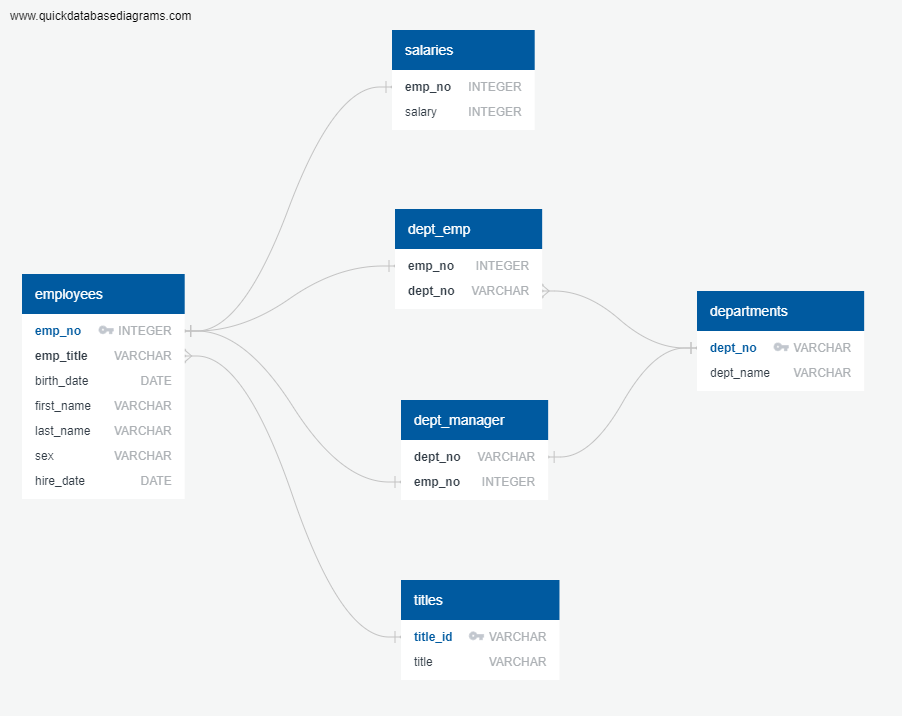
The database was engineered using PostgreSQL to model a large enterprise's employee structure. Guided by an ER diagram, the schema was normalized to Third Normal Form (3NF) to minimize redundancy and ensure data integrity. Key relationships—such as employees to departments and managers—were enforced using primary and foreign key constraints.
Each table was purpose-built to reflect distinct entities like job titles, salary history, and departmental roles. Data types were selected for performance and accuracy, and CSV data was imported through structured SQL commands to maintain referential integrity. This foundation enabled efficient querying and scalable analysis.
Data Analysis
Using SQL, a series of analytical queries were developed to extract meaningful insights from over 300,000 employee records. These queries explored employee demographics, departmental assignments, management structures, and hiring trends.
Key analyses included identifying employees hired in specific years, mapping managers to departments, and filtering by attributes such as name, gender, and department. Aggregations, such as frequency counts of last names, highlighted patterns within the workforce. The queries demonstrated effective multi-table joins, conditional filtering, and data grouping to support operational and strategic decision-making.
Conclusion
This project demonstrates end-to-end proficiency in relational database design, SQL data engineering, and business-driven data analysis. Through efficient schema design, normalized modeling, and insightful querying, the system is optimized for large-scale enterprise analytics. The challenge enhanced my ability to manage structured datasets, optimize SQL queries, and extract meaningful patterns—skills critical for roles in data analytics, business intelligence, and backend data engineering.